Step 1 — Prepare the Slow Cooker and Layer the Beef
Spray the interior of a 5- to 6-quart slow cooker with nonstick cooking spray, coating the bottom and lower sides where the beef will have direct contact with the insert. Break the raw ground beef into small, roughly uniform pieces — aim for golf ball-sized or smaller — and distribute them in an even layer across the entire bottom of the insert. Press the pieces down slightly to flatten them into a consistent layer rather than uneven mounds that would cook unevenly. Do not season the beef at this stage — the seasoning comes entirely from the sauce mixture poured over.
Step 2 — Add the Macaroni
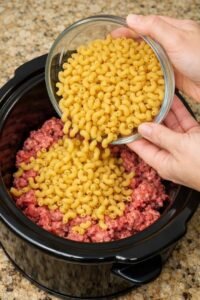
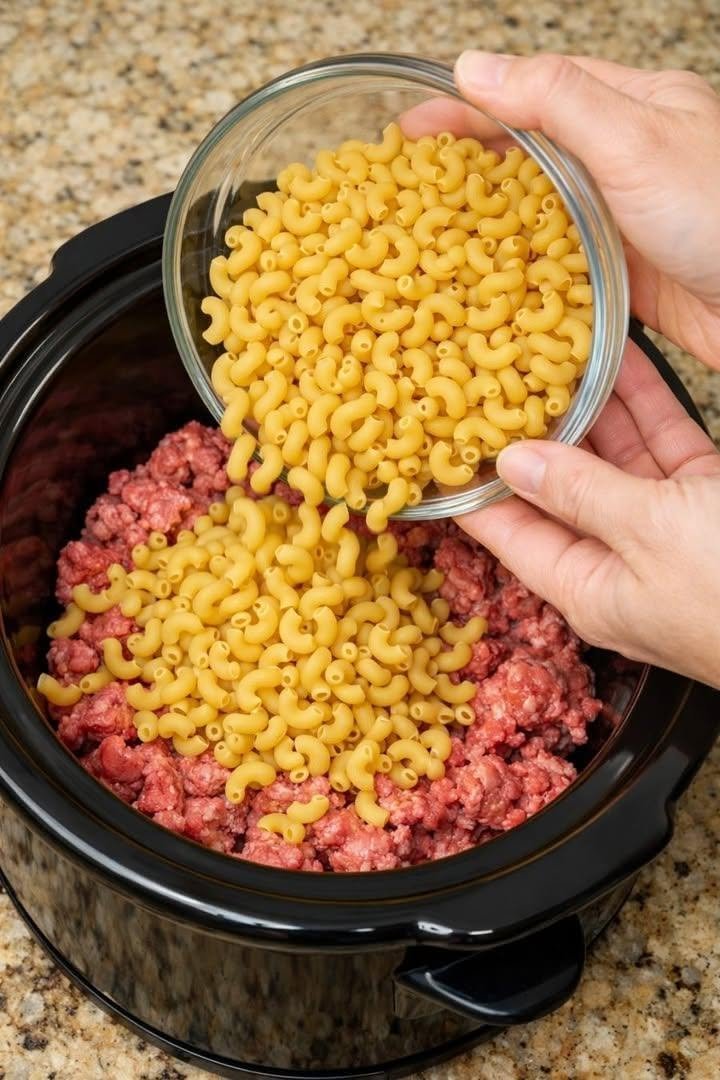
Pour the dry elbow macaroni directly over the raw beef layer, spreading it into as even a distribution as possible from edge to edge of the insert. Do not stir the macaroni into the beef — keeping the layers separate at this stage means the macaroni will be fully covered by the sauce poured over it in the next step, ensuring complete liquid contact from the start of the cook.
Step 3 — Make and Pour the Sauce
In a medium bowl or large measuring cup, whisk the jarred pasta sauce, beef broth, and kosher salt together until fully combined and uniform in consistency. Pour the sauce mixture evenly and slowly over the macaroni layer, moving the stream back and forth across the entire surface so the sauce distributes across the full area of the insert rather than pooling in the center. Use the back of a spoon to gently press down any macaroni pieces sitting above the liquid level, submerging them in the sauce. Avoid vigorous stirring that would break up the layering — the goal at this stage is complete liquid contact for all the macaroni, not a fully integrated mixture.
Step 4 — Cook and Stir at Halfway
Cover the slow cooker and cook on HIGH for 2 to 2½ hours or on LOW for 4 to 4½ hours. At the halfway point — 1 hour on HIGH or 2 hours on LOW — lift the lid and give the contents a thorough stir, breaking up any remaining clumps of beef and turning everything from the bottom up to redistribute the macaroni through the sauce and ensure even cooking throughout the insert. This mid-cook stir is the one essential intervention in an otherwise hands-off recipe — without it, the beef layer can remain partially clumped and the macaroni can cook unevenly. Replace the lid promptly and continue cooking until the macaroni is tender throughout and the beef is fully cooked through.
Step 5 — Fold in the Cheese
Once the macaroni is tender and the beef is cooked through, turn the slow cooker to WARM or OFF. Sprinkle the shredded cheddar over the surface in two or three additions, folding gently after each addition rather than adding it all at once. The folding motion — turning the pasta over itself from the bottom up — distributes the melting cheese through the entire pot evenly and produces a creamier, more cohesive sauce than stirring the cheese into the center alone. Allow the cheese to melt fully between additions before adding more. Taste the finished dish and adjust the salt if needed.
Step 6 — Rest and Serve
Cover and let the dish rest on WARM for 5 to 10 minutes. During this rest, the pasta continues to absorb some of the surrounding sauce and the dish firms and tightens to the proper consistency — thick enough to hold its shape in the bowl but still saucy enough to be fully coated with the tomato-cheese sauce in every bite. Serve directly from the slow cooker with additional shredded cheddar and freshly ground black pepper over each portion.
Tips for the Best Results
Break the beef into small, even pieces before spreading. Evenly sized, small pieces of raw beef spread across the bottom of the insert cook more uniformly than large, uneven chunks. They also break apart more easily at the mid-cook stir, producing a more evenly distributed finished dish rather than discernible chunks of beef isolated in the pasta.
Don’t skip the mid-cook stir. The halfway stir is the single technique that separates a properly made version of this dish from a clumpy, unevenly cooked one. The beef layer at the bottom of the insert is partially cooked by the halfway point and breaks apart readily with a spoon; stirring it through the pasta and sauce at this stage ensures even distribution and even cooking for the remainder of the cook.
Use a flavorful jarred pasta sauce. The pasta sauce is the primary flavoring agent for the entire dish. A robust, well-seasoned sauce — roasted garlic, tomato basil, or a quality marinara — produces a noticeably better result than a thin, bland one. This is the one ingredient where choosing quality over convenience makes the most perceptible difference in the finished dish.
Fold the cheese in gradually. Adding the full cup of cheese at once and stirring vigorously can produce a grainy, separated result as the cheese hits the hot tomato sauce. Adding it in two or three smaller additions and folding gently between each addition gives the cheese time to melt smoothly and integrate into the sauce evenly, producing a creamy finish rather than a stringy or clumped one.
Let it rest before serving. The five to ten-minute covered rest after the cheese is incorporated is when the dish reaches its ideal consistency. The pasta absorbs the excess sauce and the mixture tightens from soupy to properly saucy. Serving immediately after the cheese is folded in often produces a dish that looks thinner than it will be after a brief rest.
Frequently Asked Questions
Do I really not need to brown the beef first?
For this recipe, no — and the reason has to do with the fat content and the cooking environment. The beef is spread in a thin, even layer across the bottom of the insert where it is in direct contact with the heat; it cooks through reliably over the two-hour HIGH cook time without the need for pre-browning. What pre-browning provides is Maillard reaction browning — the savory, complex flavor that develops when beef’s surface proteins and sugars brown at high temperatures. Without it, the beef in this dish has a more gently cooked, braised character rather than a browned one. Both are good; the braised character is actually well suited to this sauce-heavy, one-pot style. If you prefer the more complex flavor that pre-browning provides, brown the beef in a skillet, drain the excess fat, and add it to the slow cooker in place of the raw beef — the finished dish will have a noticeably richer, more developed flavor.
Can I use a different pasta shape?
Yes, with some adjustments. Small shells, ditalini, and small rotini all work well with the same liquid quantity and timing as elbow macaroni. Slightly larger shapes like penne or ziti may need an additional 15 to 30 minutes and possibly a small splash of additional broth if the liquid is absorbed before the pasta is fully cooked. Very large shapes are not suitable for this method. Egg noodles absorb liquid faster than semolina pasta and become mushy — not appropriate here.
Can I make this vegetarian?
Yes. Replace the ground beef with one and a half cups of cooked lentils (brown or green) or one 15-ounce can of drained and rinsed kidney beans added at the beginning of the cook. Use vegetable broth in place of beef broth. The lentil version produces a dish that’s very close in texture and flavor to the beef original; the kidney bean version has a chunkier, more substantial bite. Both are good options for a vegetarian household or for stretching the recipe economically.
What do I do if the pasta absorbs all the liquid before it’s tender?
Add a quarter cup of warm beef broth or warm water around the edges of the insert, replace the lid, and continue cooking for another 15 to 20 minutes. The added liquid will be absorbed quickly by the undercooked pasta and resume the hydration process. This situation is more common in slow cookers that run hotter than average — check at the low end of the timing range and add liquid early if the insert looks dry before the pasta is fully cooked.
Can I add vegetables?
Yes. Frozen mixed vegetables, frozen corn, or frozen peas scattered over the macaroni before the sauce is poured in will cook through alongside the pasta and beef with no additional time or liquid required. Fresh vegetables that require more cooking time — diced bell pepper, diced onion, sliced mushrooms — are best added at the beginning of the cook beneath or alongside the beef. Canned vegetables (corn, diced tomatoes, black beans) can be stirred in at the mid-cook stir or at the end with the cheese. Any of these additions extend the recipe toward a more complete one-pot meal.
Variations Worth Trying
Cheeseburger macaroni version: Replace the pasta sauce with one 15-ounce can of diced tomatoes (undrained) and one tablespoon of yellow mustard added to the broth mixture. Add half a teaspoon of garlic powder and half a teaspoon of onion powder to the sauce. Fold in the cheddar as directed and finish with a tablespoon of ketchup stirred through. The result is a cheeseburger-flavored beef and macaroni that’s particularly popular with children and anyone who loves a good drive-through reference point in home cooking.
Italian beef and macaroni version: Replace the cheddar with shredded mozzarella and add a teaspoon of dried Italian seasoning to the sauce mixture. Scatter a quarter cup of sliced black olives and a quarter cup of diced green bell pepper over the macaroni before adding the sauce. The mozzarella finish, Italian seasoning, olives, and pepper give the finished dish a character much closer to a baked pasta or lazy lasagna — a familiar, broadly loved flavor profile.
Spicy beef and macaroni version: Add one teaspoon of crushed red pepper flakes and half a teaspoon of smoked paprika to the sauce mixture before pouring. Use a spicy arrabbiata-style pasta sauce in place of the standard marinara. Replace the cheddar with Pepper Jack. The resulting dish has building heat balanced by the tomato’s acidity and the cheese’s richness — good for households that enjoy spice.
Creamy tomato version: At the same time as the cheese, stir in a quarter cup of heavy cream or half a cup of sour cream. The dairy fat enriches the tomato sauce into a creamy, slightly more luxurious finish that’s particularly good with the sharp cheddar and makes the dish feel closer to a pasta bake than a simple beef and macaroni. This is the most popular upgrade for anyone who prefers a more obviously creamy sauce.
Mexican beef and macaroni version: Replace the pasta sauce with one 15-ounce can of crushed tomatoes combined with one packet of taco seasoning. Use Pepper Jack or a Mexican cheese blend in place of cheddar. Add one 15-ounce can of drained black beans at the mid-cook stir. Finish with a squeeze of lime and a scattering of fresh cilantro. The result is a taco-inflected beef and pasta that’s distinctly different from the Italian-influenced original while using the same method and approximate ingredient count.
Serving Suggestions
Slow cooker beef and macaroni is a complete meal — protein, starch, and sauce — that needs only something fresh and slightly acidic alongside to feel balanced. A crisp green salad with vinaigrette is the ideal accompaniment: the acidity of the dressing cuts through the tomato-cheese richness of the pasta effectively. Steamed green beans, roasted broccoli, or simple sautéed zucchini serve the same function. Warm garlic bread or buttered Italian bread is excellent for mopping up the extra sauce — which is worth mopping up, particularly the tomato-cheese combination that pools at the bottom of the bowl. For a more casual family-style service, set the slow cooker on a trivet at the center of the table on WARM and let everyone help themselves, with the additional cheese and black pepper at the table for individual finishing.
Storage
Leftover beef and macaroni keeps in an airtight container in the refrigerator for up to 4 days. The pasta continues to absorb the sauce during storage and the leftovers will be considerably thicker and denser than the freshly made dish — this is expected and does not indicate a problem. Reheat on the stovetop over medium-low heat, stirring in a generous splash of beef broth or water to restore the sauce’s flowing consistency, or reheat in the microwave at medium power, covered, stirring once during heating and adding a tablespoon of liquid if needed after stirring. The beef and macaroni also freezes well for up to 3 months — thaw overnight in the refrigerator before reheating, and add more liquid than you think you need when reheating from frozen, as the pasta absorbs additional moisture during the freeze-thaw cycle.
One Pot, Six Ingredients, One Satisfying Dinner
Slow Cooker Beef and Macaroni is a recipe that has earned its place in the weekly meal plan by being reliably good, reliably easy, and reliably satisfying in a way that feeds a family well from a very short ingredient list. The technique of layering raw beef under dry pasta under a tomato-broth sauce and letting the slow cooker integrate everything over a few hours produces a finished dish that tastes like it was built with more complexity than six pantry ingredients and one pot suggest. That’s the kind of recipe that justifies keeping the slow cooker on the counter rather than stored in the cabinet — one that makes the decision of what’s for dinner an easy one.