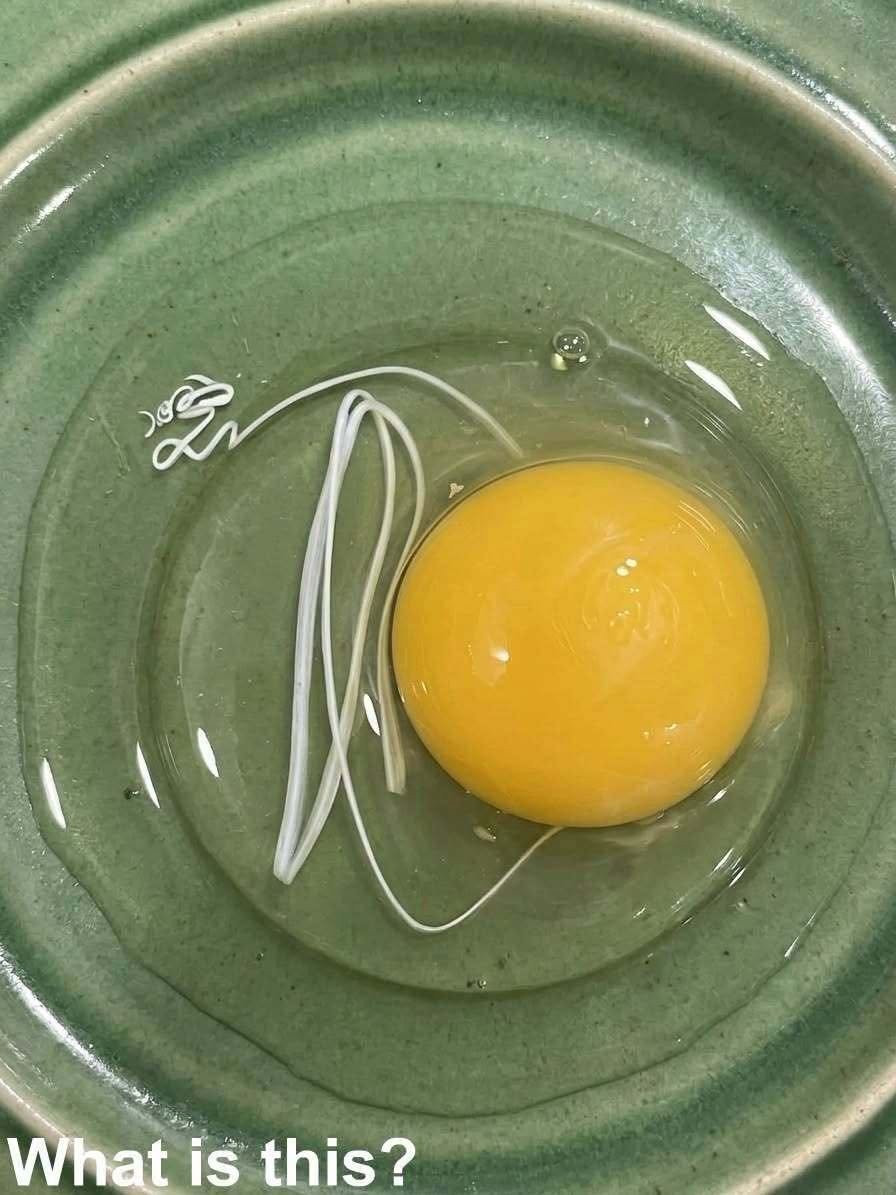
Chalaza Quick Facts:
|
Feature
|
Details
|
|---|---|
|
Composition
|
Made of mucin fibers (a type of protein), same family as egg white proteins
|
|
Location
|
Two chalazae per egg: one at each end of the yolk, anchoring it in place
|
|
Appearance
|
White, twisted, rope-like; more visible in fresh eggs
|
|
Edibility
|
Completely safe to eat; no need to remove
|
|
Function
|
Stabilizes the yolk; protects it from damage during egg formation and handling
|
💡 Key insight: The chalaza isn’t a flaw—it’s a feature. It’s nature’s way of protecting the most nutrient-dense part of the egg.
🔬 Why You Probably Never Noticed It Before
There are a few reasons the chalaza often goes unnoticed:
Why Chalazae Are Easy to Miss:
|
Reason
|
Explanation
|
|---|---|
|
They blend in
|
Chalazae are the same color and similar texture to egg white; easy to overlook when whisked or cooked
|
|
They dissolve with age
|
In older eggs, chalazae break down and become less visible; fresh eggs show them more prominently
|
|
Cooking hides them
|
When eggs are scrambled, fried, or baked, chalazae blend into the mixture and become indistinguishable
|
|
Commercial processing
|
Some commercial eggs are processed in ways that make chalazae less noticeable (though they’re still present)
|
|
We don’t look closely
|
Most of us crack eggs and cook without examining the contents—understandably!
|
When You’re Most Likely to Notice Them:
✅ Cracking eggs into a clear bowl (vs. directly into a pan)
✅ Using very fresh, farm-raised, or pasture-raised eggs (chalazae are more prominent)
✅ Poaching or frying sunny-side up (where the egg white remains visible)
✅ Separating eggs (chalazae may cling to the yolk or white during separation)
✅ Using very fresh, farm-raised, or pasture-raised eggs (chalazae are more prominent)
✅ Poaching or frying sunny-side up (where the egg white remains visible)
✅ Separating eggs (chalazae may cling to the yolk or white during separation)
🥚 Fun fact: The word “chalaza” comes from the Greek word for “hailstone,” referring to the way the strand looks like a small, white pebble suspended in the white. Ancient observers weren’t wrong—they just didn’t have food science blogs to explain it.
🥘 Should You Remove the Chalaza Before Cooking?
Short answer: No, you don’t need to.
When You Might Choose to Remove It:
|
Scenario
|
Why You Might Remove It
|
How to Remove It
|
|---|---|---|
|
Making custards or silky sauces
|
Chalazae can create tiny textural variations in ultra-smooth preparations
|
Use a small spoon or fork to lift it out before whisking
|
|
Poaching eggs for presentation
|
Some chefs prefer a perfectly uniform appearance
|
Gently lift with the tip of a knife or small spoon
|
|
Personal preference
|
Some people simply prefer not to see or feel it
|
Remove before cooking; no impact on flavor or nutrition
|
|
Feeding very young children
|
Some parents prefer to minimize any unusual textures
|
Remove if it provides peace of mind; not required for safety
|
Why Leaving It In Is Usually Best:
✅ It’s nutritious: Chalazae contain the same high-quality proteins as the rest of the egg white
✅ It’s harmless: No risk of parasites, contamination, or digestive issues
✅ It’s a freshness indicator: Prominent chalazae signal a fresh, high-quality egg
✅ It saves time: No extra step in your cooking routine
✅ It reduces waste: Every part of the egg is usable and nourishing
✅ It’s harmless: No risk of parasites, contamination, or digestive issues
✅ It’s a freshness indicator: Prominent chalazae signal a fresh, high-quality egg
✅ It saves time: No extra step in your cooking routine
✅ It reduces waste: Every part of the egg is usable and nourishing
🍳 Chef’s tip: If you’re making a dish where texture matters (like a delicate custard), strain the egg white through a fine-mesh sieve to remove chalazae and any loose membrane. For everyday cooking, don’t stress about it.
🥚 Chalaza vs. Real Concerns: How to Tell the Difference
While chalazae are harmless, it’s still important to recognize signs that an egg might actually be unsafe.
Chalaza (Harmless) vs. Actual Warning Signs:
|
Feature
|
Chalaza (Normal)
|
Potential Problem (Discard Egg)
|
|---|---|---|
|
Appearance
|
White, twisted, rope-like; attached to yolk
|
Pink, green, black, or iridescent discoloration; fuzzy mold
|
|
Smell
|
Neutral or mild egg scent
|
Sour, sulfuric, or rotten odor
|
|
Texture
|
Firm, slightly elastic; blends with egg white when cooked
|
Slimy, sticky, or unusually watery consistency
|
|
Yolk condition
|
Yolk is round, centered, and intact
|
Yolk is flat, broken, or discolored
|
|
Shell condition
|
Clean, uncracked shell
|
Cracked, leaking, or visibly dirty shell
|
When to Discard an Egg:
❌ Unusual odors: Any sour, rotten, or chemical smell
❌ Discoloration: Pink, green, black, or iridescent hues in white or yolk
❌ Mold or fuzz: Visible growth on shell or contents
❌ Cracked or leaking shells: Increases risk of bacterial contamination
❌ Expired date + questionable appearance: When in doubt, throw it out
❌ Discoloration: Pink, green, black, or iridescent hues in white or yolk
❌ Mold or fuzz: Visible growth on shell or contents
❌ Cracked or leaking shells: Increases risk of bacterial contamination
❌ Expired date + questionable appearance: When in doubt, throw it out
🩺 Food safety rule: Trust your senses. If an egg looks, smells, or feels “off,” discard it. But don’t mistake a natural chalaza for a problem.
🌱 Why Fresh Eggs Show More Prominent Chalazae
If you’ve noticed more visible chalazae in farm-fresh or pasture-raised eggs, there’s a reason for that.
Freshness and Chalaza Visibility:
|
Egg Type
|
Chalaza Visibility
|
Why
|
|---|---|---|
|
**Very fresh **(1–7 days)
|
Very prominent, thick, white
|
Proteins haven’t broken down; structure is intact
|
|
**Fresh **(1–2 weeks)
|
Visible but slightly less defined
|
Natural aging begins to soften protein structures
|
|
**Older **(3+ weeks)
|
Faint or barely visible
|
Chalazae dissolve over time; yolk may become less centered
|
|
Commercial/pasteurized
|
Often less visible
|
Processing and storage conditions affect protein stability
|
What This Means for You:
✅ Prominent chalazae = fresh egg: A good sign when buying from farmers’ markets or local sources
✅ Faint chalazae = older egg: Still safe to eat if within expiration and properly stored
✅ No chalaza visible = very old or processed: Not necessarily bad, but check other freshness indicators
✅ Faint chalazae = older egg: Still safe to eat if within expiration and properly stored
✅ No chalaza visible = very old or processed: Not necessarily bad, but check other freshness indicators
🥚 Pro tip: To test egg freshness at home, place it in a bowl of water. Fresh eggs sink and lay flat; older eggs stand upright or float due to air cell expansion. This is a more reliable indicator than chalaza visibility alone.
🍳 Cooking Tips: Working With (or Around) Chalazae
Whether you leave chalazae in or remove them, here’s how to handle eggs with confidence.
For Everyday Cooking:
✅ Don’t overthink it: Chalazae blend seamlessly into scrambled eggs, omelets, and baked goods
✅ Whisk thoroughly: A good whisk breaks up chalazae and ensures even mixing
✅ Use fresh eggs for poaching: Prominent chalazae help keep the yolk centered for beautiful poached eggs
✅ Save time: Skip the removal step unless your recipe specifically calls for ultra-smooth texture
✅ Whisk thoroughly: A good whisk breaks up chalazae and ensures even mixing
✅ Use fresh eggs for poaching: Prominent chalazae help keep the yolk centered for beautiful poached eggs
✅ Save time: Skip the removal step unless your recipe specifically calls for ultra-smooth texture
For Precision Cooking:
✅ Strain for custards: Pass egg whites through a fine-mesh sieve to remove chalazae for silky sauces
✅ Separate carefully: When separating eggs, let the chalaza stay with the white or yolk—either works
✅ Use room-temperature eggs: Easier to separate and whisk; chalazae are more pliable
✅ Separate carefully: When separating eggs, let the chalaza stay with the white or yolk—either works
✅ Use room-temperature eggs: Easier to separate and whisk; chalazae are more pliable
For Presentation:
✅ Poaching tip: Add a splash of vinegar to poaching water; it helps egg whites cohere neatly around the yolk (chalaza and all)
✅ Frying tip: Cook sunny-side up eggs over medium-low heat; chalazae will soften and blend in
✅ Baking tip: Chalazae have no impact on cakes, cookies, or breads—mix and bake as usual
✅ Frying tip: Cook sunny-side up eggs over medium-low heat; chalazae will soften and blend in
✅ Baking tip: Chalazae have no impact on cakes, cookies, or breads—mix and bake as usual
🥄 Kitchen hack: If you accidentally get a chalaza in your whisked eggs and want to remove it, dip the tip of a clean spoon into the mixture and lift it out. It usually clings to the spoon easily.
❓ Frequently Asked Questions
Q: Is the chalaza the same as the egg’s “umbilical cord”?
A: Not exactly. The chalaza anchors the yolk within the egg, but it’s not connected to the developing chick. In fertilized eggs, the embryo develops on the yolk’s surface (the blastodisc), not from the chalaza.
A: Not exactly. The chalaza anchors the yolk within the egg, but it’s not connected to the developing chick. In fertilized eggs, the embryo develops on the yolk’s surface (the blastodisc), not from the chalaza.
Q: Can you eat the chalaza raw?
A: Yes. Chalazae are safe raw or cooked. However, consuming raw eggs carries a small risk of salmonella regardless of chalaza presence. Use pasteurized eggs for raw preparations like Caesar dressing or homemade mayo.
A: Yes. Chalazae are safe raw or cooked. However, consuming raw eggs carries a small risk of salmonella regardless of chalaza presence. Use pasteurized eggs for raw preparations like Caesar dressing or homemade mayo.
Q: Do organic or pasture-raised eggs have more chalazae?
A: They may appear more prominent because these eggs are often fresher when purchased. The chalaza itself isn’t different—it’s just less degraded due to shorter time between laying and consumption.
A: They may appear more prominent because these eggs are often fresher when purchased. The chalaza itself isn’t different—it’s just less degraded due to shorter time between laying and consumption.
Q: Why do some eggs have two yolks—and do they have extra chalazae?
A: Double-yolk eggs occur when a hen releases two yolks in one cycle. Each yolk typically has its own pair of chalazae. These eggs are safe to eat and often larger than standard eggs.
A: Double-yolk eggs occur when a hen releases two yolks in one cycle. Each yolk typically has its own pair of chalazae. These eggs are safe to eat and often larger than standard eggs.
Q: Can chalazae cause allergies?
A: No. Chalazae are made of the same proteins as egg white. If you’re allergic to eggs, you’re allergic to the proteins throughout the egg—not specifically the chalaza.
A: No. Chalazae are made of the same proteins as egg white. If you’re allergic to eggs, you’re allergic to the proteins throughout the egg—not specifically the chalaza.
Q: Do commercial egg producers remove chalazae?
A: Generally, no. Chalazae are natural and harmless. Some processing methods may make them less visible, but they’re rarely removed intentionally.
A: Generally, no. Chalazae are natural and harmless. Some processing methods may make them less visible, but they’re rarely removed intentionally.
Q: Can you see chalazae in hard-boiled eggs?
A: Sometimes. After boiling, chalazae may appear as small, white, twisted bits near the yolk. They’re fully cooked and safe to eat.
A: Sometimes. After boiling, chalazae may appear as small, white, twisted bits near the yolk. They’re fully cooked and safe to eat.
**Q: Are chalazae more common in certain egg colors **(brown, white, blue)
A: No. Chalaza presence and visibility depend on freshness and hen biology, not shell color. Shell color is determined by breed, not egg quality.
A: No. Chalaza presence and visibility depend on freshness and hen biology, not shell color. Shell color is determined by breed, not egg quality.
Q: What if I see something that looks like a chalaza but is black or green?
A: Discard the egg. Chalazae are always white or off-white. Unusual colors can indicate spoilage, bacterial growth, or contamination.
A: Discard the egg. Chalazae are always white or off-white. Unusual colors can indicate spoilage, bacterial growth, or contamination.
Q: Do other birds’ eggs have chalazae?
A: Yes. Chalazae are found in the eggs of most bird species. They serve the same yolk-stabilizing function across species.
A: Yes. Chalazae are found in the eggs of most bird species. They serve the same yolk-stabilizing function across species.
💙 A Compassionate Closing Thought
If you’re reading this because you just spotted a mysterious white string in your egg—or because you’ve been quietly worried about something you saw weeks ago—please know:
🥚 Your caution is valid. Wanting to know what you’re eating shows care, not paranoia. Curiosity, not fear, is the best response.
🥚 Nature is clever. The chalaza isn’t a flaw—it’s a beautifully designed feature that protects the yolk, the egg’s most nutrient-rich part.
🥚 You’re not alone. Millions of people have cracked an egg, seen the chalaza, and wondered. Asking questions is how we learn.
🥚 Freshness is a gift. That visible chalaza? It’s a quiet signal that your egg is fresh, wholesome, and full of nourishment.
🥚 Nature is clever. The chalaza isn’t a flaw—it’s a beautifully designed feature that protects the yolk, the egg’s most nutrient-rich part.
🥚 You’re not alone. Millions of people have cracked an egg, seen the chalaza, and wondered. Asking questions is how we learn.
🥚 Freshness is a gift. That visible chalaza? It’s a quiet signal that your egg is fresh, wholesome, and full of nourishment.
That white string isn’t a warning.
It’s a signature.
A mark of quality.
A tiny testament to the intricate design of something as simple as an egg.
A mark of quality.
A tiny testament to the intricate design of something as simple as an egg.
However your own kitchen discoveries unfold, may you approach them with curiosity, compassion, and the confidence that comes from understanding.
Because sometimes, the scariest things are just nature being nature.
And sometimes, the best response is simply to whisk it in, cook it up, and enjoy.
Have you ever noticed the chalaza in your eggs? Did you know what it was? Share your kitchen discoveries, questions, or egg stories respectfully in the comments below. 🥚