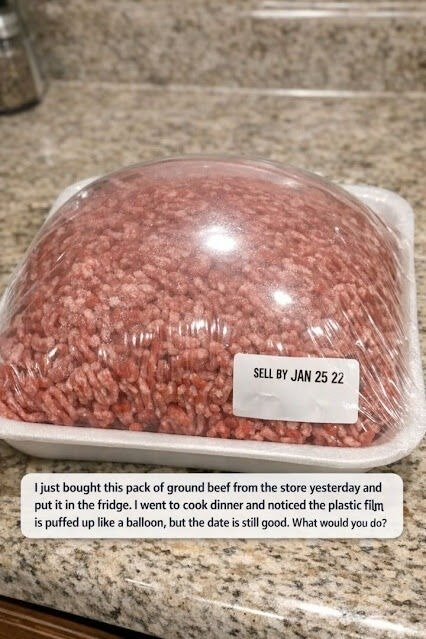
When bacteria multiply in food, they produce gases as byproducts of their metabolism. If your ground beef package is bloated, it means gas is building up inside—gas that comes from microbial activity.
What kind of bacteria?
-
Spoilage bacteria – These won’t necessarily make you sick, but they’ll make the meat smell and look unpleasant. They’re nature’s way of saying “don’t eat this.”
-
Pathogenic bacteria – These are the dangerous ones (like certain strains of E. coli or Salmonella). They can cause serious food poisoning, and they don’t always change the smell or appearance of meat.
The bloating itself doesn’t tell you which type is present—only that something is growing in there.
2. Temperature Abuse
If the meat was stored at too warm a temperature at any point—during transport, in the store, or in your fridge—bacteria can multiply rapidly. Even a few hours above 40°F (4°C) can accelerate spoilage.
3. Packaging Failure
Rarely, a packaging defect can allow air in or gases to form without spoilage. But this is much less common than bacterial growth.
4. Natural Meat Enzymes
In very fresh meat, natural enzymes can sometimes release gases. But this is unlikely in ground beef that’s been packaged for retail sale.
What About the Date?
The sell-by or use-by date is not a guarantee of safety—it’s the manufacturer’s estimate of peak quality. Bacteria don’t read calendars. If the meat has been mishandled, it can spoil well before the date on the package.
A bloated package with a “good” date is still a bloated package. Trust the physical signs, not the printed date.
What to Do Next
Step 1: DO NOT Open the Package
Whatever you do, don’t open that puffed-up package in your kitchen. If harmful bacteria are present, opening it could release them onto your counters, sink, and other surfaces.
Step 2: Inspect Through the Plastic
Look closely at the meat:
-
Color: Is it still bright red? (Note: the inside of ground beef can naturally be darker—that’s normal. But if it’s brown or gray all the way through, that’s a sign of spoilage.)
-
Liquid: Is there excessive liquid? Does it look slimy?
-
Odor: Can you smell anything through the package? (If it smells sour, ammonia-like, or just “off,” that’s a bad sign.)
Step 3: Trust Your Nose (Carefully)
If you must open it (and you really shouldn’t if it’s bloated), take it outside or to a well-ventilated area. Open it away from your face. If it smells bad—sour, sulfurous, or just “not right”—throw it away immediately.
Step 4: When in Doubt, Throw It Out
This is the golden rule of food safety. Ground beef is cheap; food poisoning is not. A trip to the ER costs a lot more than a new pack of meat.
How to Return or Dispose of It
If you just bought it:
-
Take it back to the store with your receipt. Most reputable grocers will refund or replace spoiled meat, even if the date is still good.
-
Show them the bloated package. They need to know there might be an issue with their supply.
If you’re disposing of it:
-
Double-bag it in plastic bags so animals can’t get to it.
-
Place it in an outside trash can immediately.
-
Wash your hands thoroughly after handling the outer package.
How to Prevent This in the Future
1. Check Packages Before Buying
-
Give the package a gentle squeeze. It should feel firm but not puffed up.
-
Look for any leaks, tears, or excessive liquid.
2. Get It Home Quickly
-
Meat should be one of the last things you pick up at the store.
-
In hot weather, use a cooler bag or ice pack.
-
Refrigerate immediately (within 2 hours, or 1 hour if it’s above 90°F outside).
3. Store Properly
-
Keep ground beef in the coldest part of your fridge (usually the back of the bottom shelf).
-
Use within 1-2 days, or freeze immediately if you won’t use it soon.
4. Trust Your Senses
-
Sight: Discoloration, sliminess
-
Smell: Sour, ammonia, sulfur
-
Touch: Sticky or tacky texture
If any of these are off, don’t cook it. Don’t taste it. Don’t hope it’s okay. Throw it out.
A Note on “Smelling Okay” But Still Bloated
Some pathogenic bacteria don’t produce strong odors. Meat can smell perfectly fine and still harbor dangerous microbes. That bloated package is evidence of gas production—which means microbial activity. Even if it smells okay, don’t take the risk.
The Bottom Line
That puffed-up package of ground beef is not a mystery—it’s a message from your food saying, “Something is growing in here.”
-
Do not open it in your kitchen.
-
Do not cook and hope for the best.
-
Do not trust the date over the physical signs.
Return it, throw it out, or exchange it. Then go buy another pack—one that’s flat, cold, and clearly safe.
Your health is worth more than a few dollars of meat.